What Is a VLA Model? Vision-Language-Action Models Explained in Plain English
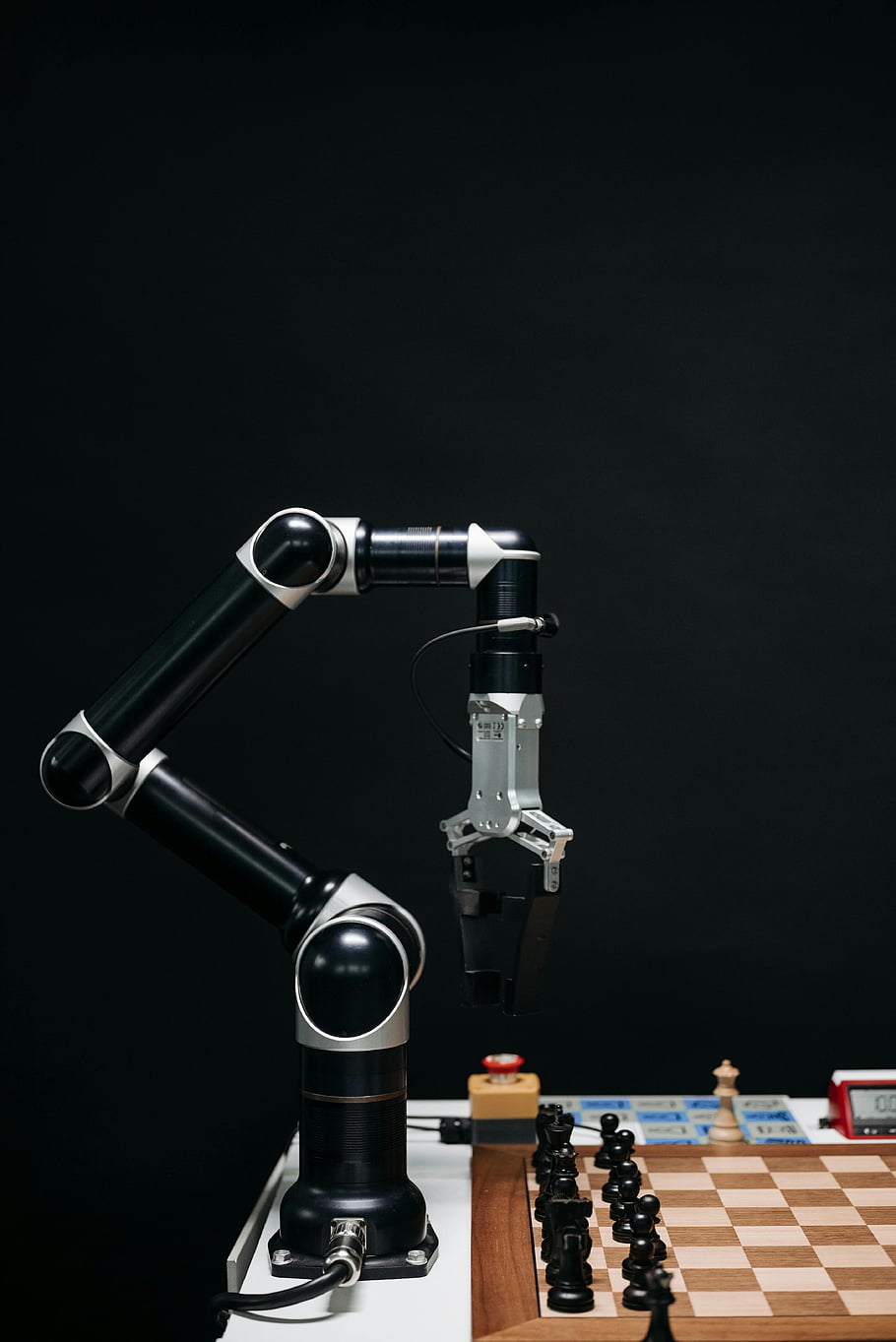
Photo: Hippopx (public domain). Illustrative image.
What is a VLA model?
VLA stands for vision-language-action. It is a type of AI model built for robots. It takes two inputs — what the robot sees through its cameras, and an instruction in plain language — and produces one output: physical actions. “Pick up the metal bracket and place it in the tray.” The model sees the bin, understands the sentence, and moves the arm.
That sounds simple. It is the hardest problem in robotics, because it joins three things that used to be separate: seeing, understanding language, and moving a body in the real world.
How is it different from a normal robot?
A traditional industrial robot is programmed task by task. An engineer writes precise instructions for one job — weld this seam, pick up this part from this exact spot — and if anything changes, the program breaks. A VLA model generalises. Because it borrows understanding from the vast amounts of language and vision data it was trained on, the same model can be asked to do many different things: tie a bow on a gift box, serve food with tongs, pipette a liquid, or sort car parts. It has not been programmed for each task; it has learned a general ability to connect words and images to movements.
Google DeepMind describes this as the path from robots that repeat one motion to robots that can work in unstructured, real-world environments — kitchens, warehouses, factory floors — where nothing is ever in exactly the same place twice.
How does a VLA model work?
In plain terms, three parts work together:
- Vision. The model reads camera images, so it knows what is in front of the robot and where things are.
- Language. It reads the instruction, so it knows what the human wants — including instructions it has never seen before, phrased in ordinary words.
- Action. It outputs movements — joint angles, gripper positions — that carry out the instruction, adjusting as the scene changes.
Training combines two kinds of data: robot demonstrations (recordings of robots doing tasks, showing which movements work) and the web-scale language and vision data that gives the model its general understanding. The newest models add a reasoning step on top: an embodied reasoning model tracks the workflow while the action model controls the hands and arms.
What can VLA models do today?
The current state of the art is Gemini Robotics 2.5, announced by Google DeepMind on 10 November 2026. Tested across more than 200 distinct tasks, it achieves a 30% to 100% higher success rate than previous baselines, depending on task type, while completing tasks 20% to 30% faster. On active Mercedes-Benz production lines, Apptronik Apollo 2 humanoids using the model hit a 96% success rate at automotive kitting — sorting parts from bulk bins into trays. The open-weight counterpoint is Runway’s Praxis-1, released the same week with downloadable weights.
What are the limits?
Four, and they matter more than the demos:
- Data hunger. Robots need demonstrations, and demonstrations are slow and expensive to collect — far slower than scraping text from the web. This is why VLA progress trails language-model progress.
- Safety. A chatbot’s mistake is a wrong sentence; a robot’s mistake is a broken object or an injured person. Gemini Robotics 2.5 adds inference-time reasoning guidance to steer around hazards, and a new ASIMOV-Jailbreak benchmark to test against adversarial instructions — but physical safety is still the field’s hardest unsolved problem.
- Speed and reliability. A 96% success rate on a factory line is impressive and still means 4 failures in 100. For a home robot, that failure rate has to fall much further.
- Availability. VLA models are rolling out to robotics partners, not to the public. You cannot download Gemini Robotics 2.5 and run it on your own robot today.
Frequently asked questions
Is a VLA model the same as a robot? No. The VLA is the brain; the robot is the body. The same model can run on different robots — Gemini Robotics 2.5 works on Apptronik’s Apollo 2 humanoid and on the Franka Duo platform — just as the same language model can run in different apps.
Will VLA models replace factory workers? The near-term picture is narrower: they take on repetitive, physically taxing work, like kitting, so technicians can focus on complex build tasks. That is how DeepMind frames the Mercedes-Benz pilot, and it matches the pattern of every automation wave so far.
What is the difference between a VLA and an AI agent? An AI agent acts in software — it writes code, books travel, answers email. A VLA acts in the physical world. Both take instructions and use tools; the VLA’s tool is a body. See What Is an AI Agent? for the software side.
Do VLA models understand the world? They connect words, images and movements well enough to do useful work. Whether that counts as understanding is a philosophical question; the practical question is whether they complete the task safely, and that is measured task by task.
Sources
- Google DeepMind — “Gemini Robotics 2.5: Accelerating Physical Intelligence” (10 November 2026): https://deepmind.google/blog/gemini-robotics-2-5-accelerates-real-world-physical-intelligence/
- FreshSynapse — “Gemini Robotics 2.5 Hits 96% on a Mercedes-Benz Factory Line”: https://freshsynapse.com/articles/gemini-robotics-2-5-mercedes-benz-96-percent-2026-11-16/
- FreshSynapse — “Runway Praxis-1: The Open-Weights Robot Model”: https://freshsynapse.com/articles/runway-praxis-1-open-weights-robot-model-2026-11-12/
- FreshSynapse — “What Is an AI Agent? A Plain-English Guide to How AI Agents Work”: https://freshsynapse.com/articles/what-is-an-ai-agent/